📄 Keyword Suggestion
Find relevant short- and long-tail keyword ideas instantly with Top Tools World.
How to use
Last updated: a year ago
Step-by-Step Guide to Using the Keyword Suggestion
- Open the tool on Top Tools World and get ready with a topic you want to explore. Think about your audience and the main theme you want to rank for.
- Choose a clear “seed” phrase. Examples: “best running shoes,” “email marketing tips,” or “Italian restaurant Chicago.” The more specific your starting point, the richer the ideas you’ll get.
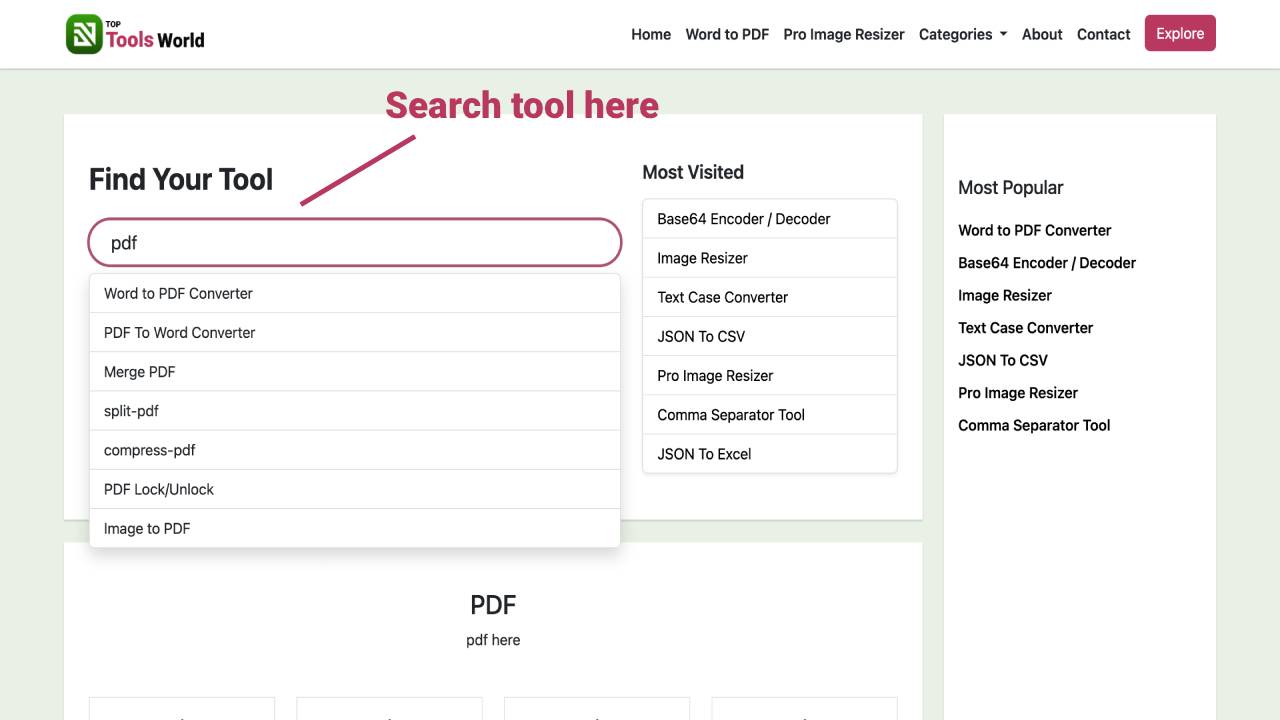
- Type your chosen phrase into the search area. Keep it natural—use the words your customers would actually type into a search engine.
- Click the main action button to generate suggestions. You’ll see a quick progress indicator so you know your results are being prepared.
- Scroll to the results section. Top Tools World neatly organizes ideas into All Suggestions, Short-Tail Keywords, and Long-Tail Keywords so you can skim and select fast.
- Review the suggestions. Short-tail ideas help you target broad topics; long-tail ideas reveal specific phrases with clear intent (great for conversions and niche content).
- Pick your winners. Copy or note down the most relevant options. Aim for a balance: one main keyword plus several supporting variations for headings, subheadings, and FAQs.
- Iterate. Try synonyms, add modifiers (best, near me, 2025, for beginners), or test alternate phrasing to uncover even more opportunities on Top Tools World.
- Plan your content. Group similar keywords into clusters and map them to individual pages, sections, or blog posts. This ensures strong topical coverage and internal linking.
- Apply and monitor. Use your chosen keywords across titles, meta descriptions, headers, and body copy. Revisit Top Tools World regularly to refresh ideas and stay ahead of trends.
Key Benefits of Using Keyword Suggestion on Top Tools World
- Ease of use: Enter a phrase, click, and get a clean, categorized list of keyword ideas.
- Accuracy: Suggestions stay tightly aligned with your topic, helping you avoid irrelevant keywords.
- Speed: Get results in seconds so you can move from research to writing without friction.
- Reliability: Consistent performance you can count on for everyday SEO tasks.
- Time-saving: The short-tail vs. long-tail split makes prioritization quick and intuitive.
- Real-world scenarios: Perfect for blog outlines, ecommerce category pages, product descriptions, landing pages, and PPC brainstorming.
- Clarity: Easy-to-understand language and grouping so beginners and pros can act on the data immediately.
Why Choose Our Keyword Suggestion? (Unique Advantages)
The Top Tools World experience prioritizes clarity, speed, and actionable insights. Instead of drowning you in noise, our Keyword Suggestion presents focused ideas that mirror how people search today. The output is structured—All Suggestions, Short-Tail, and Long-Tail—so you can instantly separate broad visibility opportunities from high-intent, conversion-friendly phrases.
Built for everyday use, the tool feels fast on both desktop and mobile. Marketers, creators, and local businesses prefer Top Tools World because it removes guesswork, enabling smarter content plans, better ad groups, and stronger on-page optimization. With dependable performance and a clean interface, it’s a tool you’ll return to again and again.
What is a Keyword Suggestion? A Complete Overview
Keyword suggestion is the process of taking a seed phrase and uncovering related queries that real people might type into search engines. This gives you a window into audience language, intent, and topic variations you may not have considered. Using Top Tools World, you’ll surface short, broad terms (short-tail) and longer, more specific phrases (long-tail) in one place.
Short-tail keywords, such as “running shoes,” attract large search volumes but come with high competition and mixed intent. Long-tail keywords—like “best running shoes for flat feet women”—have lower volume but much clearer intent, giving you a better chance to rank and convert.
Common problems this solves:
- Writer’s block: Turn a vague topic into specific, publish-ready angles.
- Content gaps: Find subtopics and questions you haven’t covered yet.
- PPC inefficiency: Expand ad groups with targeted variations and negatives.
- On-page optimization: Choose a primary keyword and supporting terms for headings and FAQs.
- Topical authority: Build clusters of related content to signal depth and relevance.
Examples:
- “Budget travel Italy” could reveal ideas like “cheap Italy itinerary 10 days,” “best hostels Rome,” and “how to travel Italy by train on a budget.”
- “Vegan protein powder” might suggest “vegan protein powder without soy,” “best vegan protein for smoothies,” and “vegan protein powder for weight loss.”
- Local intent like “plumber Denver” can expand to “emergency plumber Denver 24/7,” “water heater repair Denver,” and “plumbing inspection Denver cost.”
By using Top Tools World to explore variations, you’ll align pages with what your audience actually seeks—improving relevance, rankings, and engagement.
Advanced Tips & Best Practices
- Start broad, then niche down: Try a general keyword, note themes, then re-run more specific variants in Top Tools World.
- Use intent modifiers: Add words like “best,” “vs,” “near me,” “how to,” “review,” or the current year to reveal buyer and research intent.
- Cluster your keywords: Group closely related terms and build one strong page per cluster to avoid cannibalization.
- Map to the funnel: Mix informational queries (how to…) with transactional ones (buy, price, deals) across your site.
- Optimize smartly: Place the primary keyword in the title, H1, opening paragraph, and URL; use supporting variations in subheadings.
- Write naturally: Avoid keyword stuffing. Focus on helpful content that answers the query thoroughly.
- Localize: Add city or neighborhood names for location-based searchers (e.g., “roof repair Austin” or “coffee roasters Brooklyn”).
- Compare options: Test singular vs. plural, brand vs. generic, and common synonyms to see what resonates.
- Plan seasonally: Revisit Top Tools World before peak seasons, launches, and promotions to refresh your keyword list.
- Build briefs: Use your final list to structure outlines, FAQs, and internal links before writing.
FAQs About the Keyword Suggestion
- What is a seed keyword?
It’s the starting phrase you enter to generate related ideas. Example: “camping tent” or “email newsletter tips.” - Short-tail vs. long-tail—what’s the difference?
Short-tail is broad (e.g., “tents”), while long-tail is specific (e.g., “best waterproof camping tents for families”). Long-tail often converts better. - How many keywords should I target per page?
Use one primary keyword and 3–8 closely related supporting terms to maintain focus without dilution. - Can I use these suggestions for PPC as well as SEO?
Yes. The ideas are helpful for building ad groups, negatives, and landing page relevance. - How often should I do keyword research?
Before publishing new content, during major site updates, and quarterly to capture fresh trends. - Does the tool show search volume or difficulty?
The Keyword Suggestion focuses on idea discovery and relevance. Use your analytics or additional research methods to assess volume and competitiveness. - How do I target local audiences?
Include your city, neighborhood, or region in the seed phrase (e.g., “wedding photographer Miami”) to surface location-specific ideas on Top Tools World. - What’s the best way to use the results?
Select a primary keyword, cluster supporting ideas, and weave them naturally into titles, headings, and content sections.
For fast, reliable keyword brainstorming that turns into real content plans, keep Top Tools World bookmarked. Make it your go-to assistant for discovering short-tail visibility and long-tail intent—then publish with confidence.